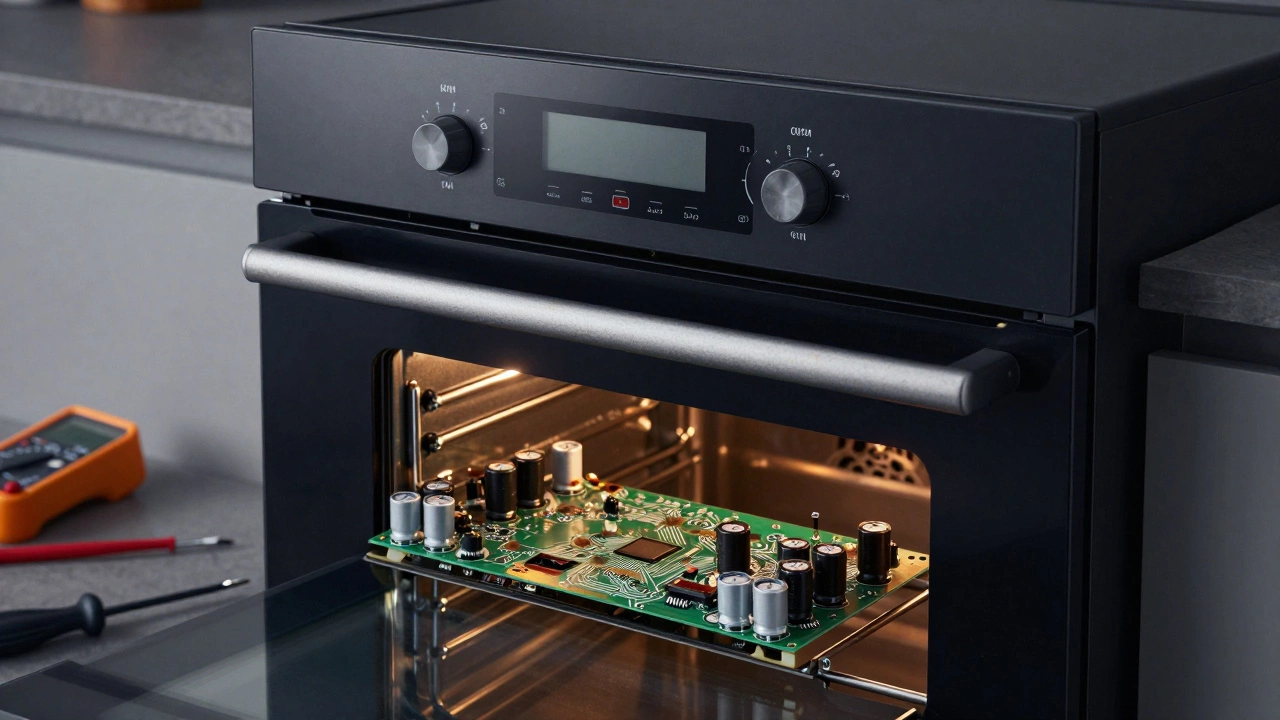
Oven Control Board Diagnostic Tool
How to Use This Tool
Answer the questions below based on your oven's symptoms and testing. This tool will help you determine if your control board is likely the issue. Remember: Always unplug the oven before inspecting internal components.
If your oven won’t heat up, the display is blank, or it’s acting weird-like turning on by itself or showing error codes-you might be dealing with a bad control board. It’s one of the most common reasons modern ovens stop working, and it’s also one of the easiest to misdiagnose. Many people replace heating elements or thermostats first, only to find out the real problem is deeper inside the control panel. Here’s how to know for sure if your oven control board is the issue.
Step 1: Check the obvious first
Before you assume the control board is dead, rule out the simple stuff. A bad control board is expensive to replace, and you don’t want to spend $200 on a new one if the problem is a tripped breaker or a blown fuse. Start with these checks:- Make sure the oven is plugged in and the circuit breaker hasn’t flipped.
- Test the outlet with another appliance to confirm it’s getting power.
- Check your home’s main electrical panel for a tripped GFCI or dedicated oven circuit.
- If your oven has a clock or timer, is it lit up? No display at all is a big red flag.
If the display works but the oven doesn’t heat, that’s different than no power at all. If nothing lights up-not even the clock-then you’re likely looking at the control board.
Step 2: Look for error codes
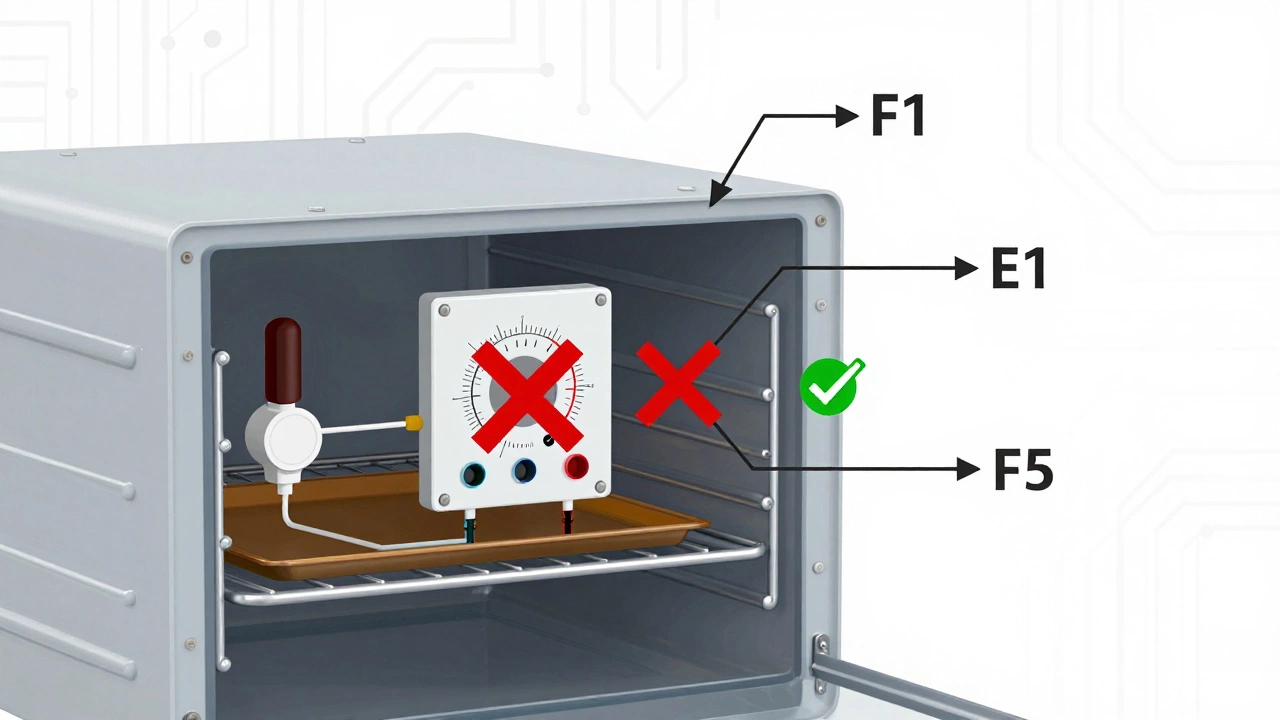
Most ovens made after 2010 have built-in diagnostics. If your oven is showing an error code like F1, F5, E1, or E9, it’s not random. These codes are sent by the control board to tell you what’s wrong. You can’t fix the code itself-you fix the part it’s pointing to.For example:
- F1 on a Whirlpool oven usually means a stuck key or faulty control board.
- E1 on a GE oven often means the temperature sensor failed, but if replacing the sensor doesn’t fix it, the board is likely misreading the signal.
- F5 on a Frigidaire oven means a communication failure between the board and another component-usually the board itself.
Don’t just Google the code. Check your oven’s manual or manufacturer’s website for the exact meaning. If the error keeps coming back after you’ve replaced sensors, switches, or relays, the control board is probably the culprit.
Step 3: Test the heating elements and thermostat
The control board sends power to the bake and broil elements. If those elements are broken, the oven won’t heat-but the board could still be fine. Use a multimeter to test them.Here’s how:
- Unplug the oven or turn off the circuit breaker.
- Remove the back panel to access the heating elements.
- Set your multimeter to ohms (Ω).
- Touch the probes to the terminals on each element.
- A good element reads between 20 and 120 ohms. If it reads OL (open loop) or 0, it’s dead.
If both elements test fine, move on to the temperature sensor. It’s usually a thin probe inside the oven cavity. Unplug it and test its resistance. At room temperature, it should read about 1000-1100 ohms. If it’s way off, replace it. If it’s fine and the oven still doesn’t heat, the control board isn’t sending power to the elements. That’s your sign.
Step 4: Listen for clicks and watch for behavior
A working control board makes small clicks when it turns components on and off. If you hear nothing when you turn the oven on, but the display is lit, that’s odd. If you hear a single click and then silence, the relay on the board may be stuck.Watch for these signs:
- The oven turns on by itself, even when not set.
- The clock resets randomly.
- The oven heats unevenly-sometimes too hot, sometimes not at all.
- Buttons on the keypad don’t respond, or they respond randomly.
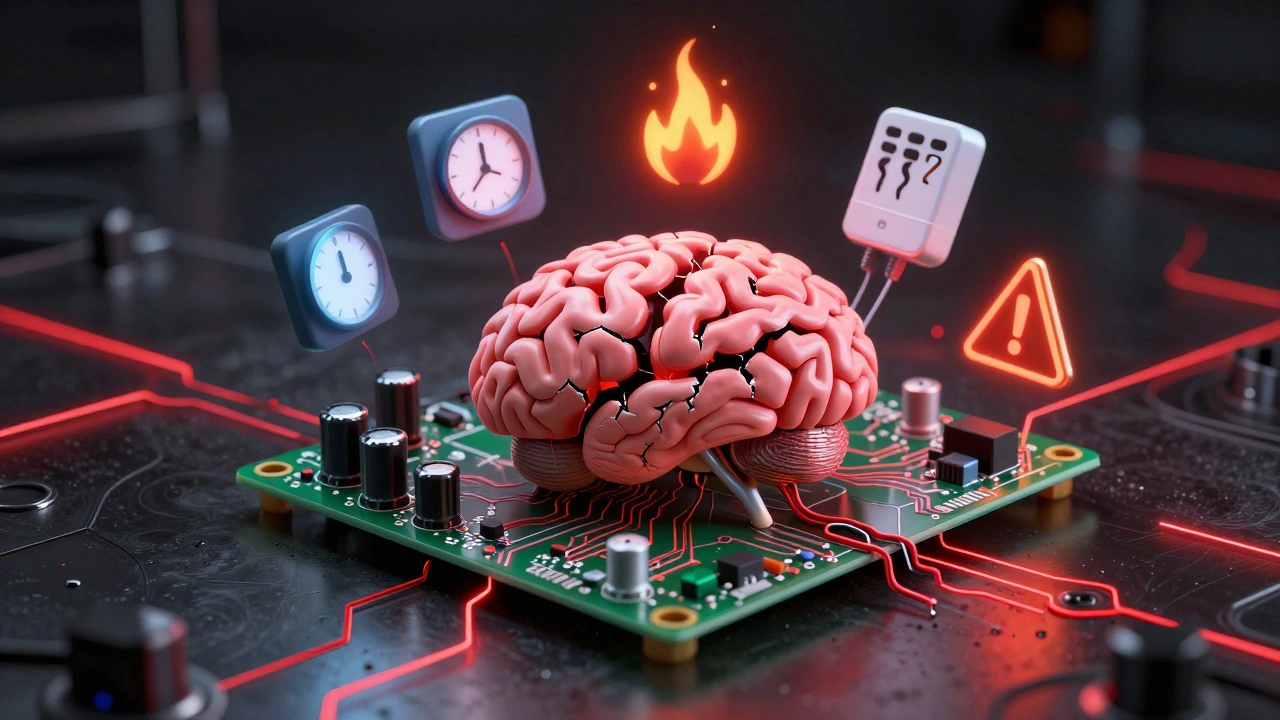
These aren’t normal. They mean the board’s microprocessor is glitching. It’s not sending clean signals. This isn’t a wiring issue. It’s not a sensor issue. It’s the brain of the oven failing.
Step 5: Check for physical damage
Sometimes, you can see the problem without tools. Unplug the oven and remove the control panel. Look at the control board inside:- Are there any burnt spots, brown marks, or melted plastic?
- Are any capacitors bulging or leaking?
- Is there a strong smell of ozone or burnt electronics?
If you see any of these, the board is dead. Even if it looks fine, moisture or power surges can fry internal circuits. You can’t see those with your eyes. But if you’ve ruled out every other part and the symptoms match, the board is guilty.
Step 6: Compare with known failures
Certain oven brands have control boards that fail more often. In Hamilton, where winters are harsh and power surges are common, these models show up often in repair shops:- Whirlpool, Maytag, KitchenAid: Their control boards are prone to capacitor failure after 6-8 years.
- GE and Hotpoint: Often fail due to moisture buildup behind the keypad.
- Frigidaire and Electrolux: The relay chips on the board burn out from constant high-heat cycles.
If your oven is 7+ years old and you’re seeing erratic behavior, it’s not bad luck-it’s expected wear. Control boards aren’t designed to last forever. They’re the most complex part, and they’re exposed to heat, voltage spikes, and humidity.
What to do if it’s bad
If you’ve gone through all these steps and the signs point to the control board, you have two choices:- Replace the board: Order the exact part number for your model. You can find it on a sticker inside the oven door or on the back panel. Don’t guess. A wrong board won’t work, even if it looks similar.
- Replace the oven: If your oven is over 10 years old and the board costs more than half the price of a new one, it’s smarter to upgrade. New models are more energy-efficient and come with better diagnostics.
Replacing the board yourself is doable if you’re comfortable with basic tools. It takes about an hour. Just take photos before you disconnect wires. Label them. Most boards plug in, but some have screws and connectors. Don’t force anything.
And don’t ignore the problem. A failing control board can cause safety issues-like the oven turning on unexpectedly or overheating. That’s not just inconvenient. It’s dangerous.
Prevent future failures
You can’t stop a control board from aging, but you can reduce stress on it:- Use a surge protector for your oven if it’s plugged into a regular outlet.
- Keep the control panel dry. Don’t spray cleaners directly on it.
- Don’t overload the oven. Constant high heat strains the board’s relays.
- Clean the oven regularly. Built-up grease can trap heat near the electronics.
These steps won’t make the board last 20 years-but they might give you another 3-5 years of reliable use.
Can a bad control board cause my oven to not heat at all?
Yes. The control board sends power to the bake and broil elements. If it’s faulty, it won’t send the signal-even if the elements themselves are perfectly fine. If the display works but the oven doesn’t heat, and you’ve confirmed the elements and sensor are good, the control board is the most likely cause.
Is it worth replacing the control board or should I buy a new oven?
If your oven is less than 8 years old and the board costs under $150, replacing it is usually worth it. If it’s older than 10 years, or the board costs more than half the price of a new oven, it’s better to replace the whole unit. New ovens are 20-30% more energy efficient and come with better safety features.
Can I test the control board with a multimeter?
You can’t directly test the board’s microprocessor, but you can test the voltage going to and from it. If you have 120V going into the board but nothing coming out to the heating elements, the board isn’t switching power. That’s a failure. Most people don’t have the tools or training to do this safely-so it’s better to rule out everything else first.
Why does my oven turn on by itself?
A malfunctioning control board can send random signals to the relay, making the oven turn on without being programmed to. This is a safety hazard. It’s often caused by a shorted capacitor or damaged circuitry inside the board. Don’t ignore this-unplug the oven and replace the board immediately.
Can a power surge damage the oven control board?
Yes. Power surges-especially during storms or when large appliances cycle on-can fry the delicate electronics on the control board. In Hamilton, where winter storms are common, this is a frequent cause of failure. Installing a surge protector for your oven is one of the cheapest ways to prevent this.