Microwave Repair vs. Replace Calculator
Determine if it makes financial sense to repair your microwave or buy a new one based on current market prices.
Recommendation
Your microwave hums loudly but the coffee stays cold. That specific frustration usually points to one broken part: the magnetron. This is the engine of your appliance, generating the microwaves that cook your food. When it fails, you face a classic home dilemma: spend money fixing an old machine or toss it and buy a new one?
For most households, replacing a magnetron is a financial trap. The parts are cheap, but the labor isn't. In 2026, with new basic microwaves costing between $80 and $120, spending $150+ on a repair rarely makes sense unless you own a high-end built-in model.
The Real Cost of Fixing a Magnetron
Let's look at the numbers. A replacement magnetron itself costs anywhere from $30 to $60 depending on the brand and wattage. If you are handy and have a multimeter, you might think this is a DIY job. But here is the catch: microwaves hold lethal electrical charges even when unplugged.
The high-voltage capacitor can store enough energy to stop your heart if touched incorrectly. Because of this risk, professional technicians charge for their expertise and insurance. In cities like Hamilton or Toronto, a service call plus labor typically runs between $100 and $150. Add the part cost, and you are looking at a total bill of $130 to $200.
Compare that to a new countertop microwave. You can pick up a reliable 1000-watt model from brands like Panasonic or GE for under $100. Even mid-range models with sensor cooking stay under $200. Unless your current microwave is a premium unit worth over $400, the math doesn't work out in favor of repair.
| Scenario | Estimated Cost | Verdict |
|---|---|---|
| New Basic Countertop Microwave | $80 - $120 | Best Value |
| Professional Magnetron Replacement | $130 - $200 | Poor Value for Standard Units |
| DIY Magnetron Replacement (Parts Only) | $30 - $60 | Risky / High Danger |
| New Built-In/Over-the-Range Microwave | $300 - $600+ | Worth Repairing Old Unit |
When Is Replacement Actually Worth It?
There are exceptions to the "buy new" rule. If you have a built-in microwave installed above your range or integrated into your cabinetry, removing and reinstalling it requires significant carpentry work. In these cases, paying $150 to fix the existing unit saves you hundreds in installation fees.
Another scenario is if you have a specialized commercial-grade microwave. These units are built to last decades and often cost $500 or more upfront. For these heavy-duty appliances, replacing the magnetron extends the life of a valuable asset.
However, for the average family using a standard countertop model from 2015 or earlier, the internal components are likely aging. The turntable motor, door switches, and control board may fail soon after you fix the magnetron. You end up throwing good money after bad.
Signs Your Magnetron Has Failed
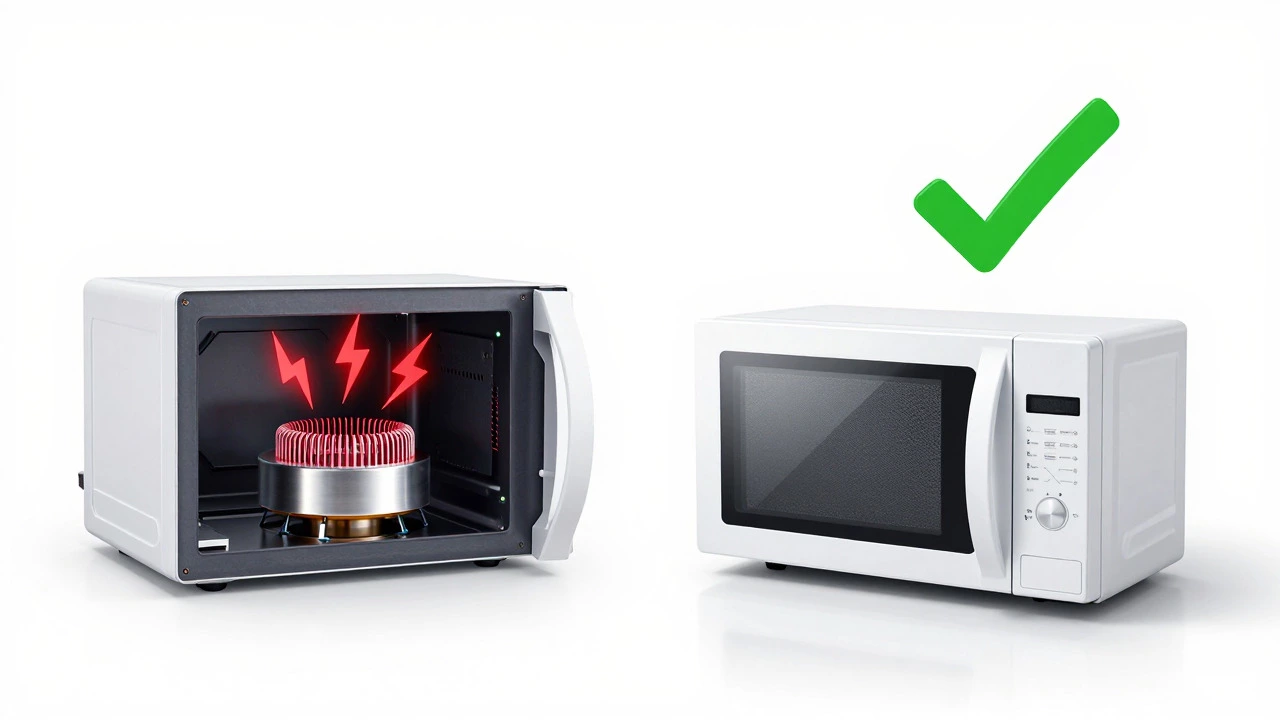
Before calling a technician, confirm the diagnosis. A dead magnetron presents clear symptoms:
- No heat, but light works: The interior light turns on, the turntable spins, and the timer counts down, but the food remains cold.
- Loud humming or buzzing: You hear a strange noise coming from the back of the unit while it runs.
- Burning smell: A distinct odor of burnt insulation or ozone suggests the magnetron has overheated or arced internally.
- Sparking inside: While this can be caused by dirty waveguides, persistent sparking often indicates a failing magnetron tube.
If your microwave does not turn on at all, the issue is likely the power cord, fuse, or control panel, not the magnetron. Don't assume the worst until you've checked the basics.
The Hidden Risks of DIY Microwave Repair
You might be tempted to save money by doing it yourself. After all, YouTube videos make it look simple. But microwaves are deceptively dangerous. Unlike a toaster or a blender, a microwave contains a transformer that steps up household voltage from 120V to over 2,000 volts.
Even after unplugging the device, the capacitor holds that charge. Technicians use a discharge probe to safely bleed off the energy. Without proper tools and training, touching the wrong terminal can cause severe injury or death.
Furthermore, reassembling the case requires precision. If the metal shielding isn't seated correctly, microwave radiation can leak. While modern units have safety interlocks, improper assembly can compromise these safeguards. Most people don't have a non-ionizing radiation meter to test for leaks at home.
What To Do Instead of Replacing the Magnetron
If the repair quote comes back high, consider these alternatives:
- Check the warranty: Some extended warranties cover major components like magnetrons. Call the manufacturer before paying anyone.
- Look for refurbished units: Retailers often sell refurbished microwaves with a 90-day warranty for half the price of new ones.
- Upgrade features: Use the opportunity to get a convection microwave or one with smart sensors. These cook more evenly and prevent burning.
- Donate or recycle: If your old unit still heats, donate it. If it's dead, take it to a local e-waste recycling center. Many municipalities in Ontario offer free drop-off days.
Making the Final Decision
Ask yourself three questions:
- Is my current microwave a high-end built-in model?
- Am I comfortable with the safety risks of high-voltage electronics?
- Will other parts likely fail within the next year?
If you answered "no" to the first and third questions, buy a new microwave. It’s safer, cheaper, and comes with a fresh warranty. Save the repair budget for appliances where labor is less dominant, like washing machines or refrigerators, where compressor repairs often justify the cost.
How much does it cost to replace a magnetron in a microwave?
The part itself costs between $30 and $60. However, including professional labor and service fees, the total cost typically ranges from $130 to $200. DIY repairs only save the labor cost but carry significant electrical risks.
Can I replace a microwave magnetron myself?
Technically yes, but it is dangerous. Microwaves contain capacitors that hold lethal electrical charges even when unplugged. Unless you have experience with high-voltage electronics and proper discharging tools, it is safer to hire a professional or replace the unit.
What are the signs of a bad magnetron?
Common signs include food not heating despite the light and turntable working, loud humming or buzzing noises during operation, a burning smell, or visible sparking inside the cavity.
Is it better to repair or replace a microwave?
For standard countertop microwaves, replacement is usually better because new units cost less than $120. Repair is only worth it for expensive built-in models or commercial units where installation costs are high.
How long does a microwave magnetron last?
A typical magnetron lasts between 7 to 10 years with regular use. Factors like running the microwave empty or using metal containers can shorten its lifespan significantly.